2007-04-29

REN wants nuclear power in Portugal

In Jornal de Negocios of 2007-03-27 was an article after an interview with the current president of REN (the electricity grid operator in Portugal) Jose Penedo.

He had some really amazing things to say:

"No cannot think that other countries will take of nuclear power. It has to be resolved by us". That would strike most people as a very weird statement since Portugal does not have nuclear power nor do the current government want to have it! So there is nothing to be taken care or be resolved...

Gladely he thinks that solar and wind power together will cover 50% of Portugal needs for electricity (current usage I guess). So instead of building nuclear power plants as Jose wants one should increase the efficiency of the use of electricity. Doubling the efficiency does not seem very much out of reach!!! At least considering the inefficiency of today ...

Furthermore Jose wants that someone should go to prison for not building a hydroelectric dam in Foz Coa. Jose thinks that UNESCO attributed Foz Coa as World Heritage site made Foz Coa into a prisoner. Go figure what is going on in the grey matter of that guy!!!

Since he is head of the only company in Portugal that distributes electricity he of course wants the company to stay in business. Solar panels and wind power (and wave power) would generate plenty of electricity for REN to distribute.

But it is a bit extreme to introduce nuclear power plants in Portugal and to drown a world heritage site just to stay in business ...

Labels: , , , , ,

2007-02-27

Public consultation of GM maize in Portugal

I just participated in an ongoing public consultation on GM maize in Portugal that is open until March 1 2007 (ie thursday). I sent my comments to "Exmo Sr Presidente de Instituto do Ambiente" via email to cpogm at iambiente dot pt.

Read about it here.

My letter is as follows:

Contributo do Johan Benesch para o processo de Consulta Pública relativo às notificações para a libertação deliberada multi-anual de plantas geneticamente modificadas –
Processos B/PT/06/06 e B/PT/07/01.

Espero e desejo que a decisão final sobre estes dossieres seja efectivamente norteada pelo Princípio da Precaução e que o aspecto da irreversibilidade de qualquer libertação ambiental de transgénicos, tal como reconhecido pela Directiva 18/2001/EC , seja sentido e prevaleça sobre miragens tecnológicas desnecessárias e arriscadas.

Abreviatura: GM - geneticamente modificado/a/os/as

Comentários em geral
1.Qual importância tem o Princípio da Precaução em Portugal? Se há uns casos óbvios para aplicação do Princípio da Precaução, são estes.
2.Avaliação destes tipos de projectos deve ser feito em base científica e experiências prévias.
3.O que diz a legislação portuguesa sobre os interesses ambientais na agricultura?
4.O que diz a legislação portuguesa sobre a comparação entre as tecnologias novas e as melhores práticas ( ou seja benchmarking) na agricultura?
5.O que diz a legislação portuguesa sobre a substitição dos métodos ou dos materiais que têm impactos negativos (na saúde humana e no ambiente) por métodos ou materiais que têm um melhor impacto para o ambiente? Ou seja, o Princípio da Substitução.
6.Por que são os sequenciais NDA (DNA) são classificados como CBI? Devem ser descritos nas patentes!
7.Ambos os pedidos não incluem expêriencias doutros países sobre os impactos ambientais destes tipos de produtos e especificamente destes GMs
8.Ambos pedidos não incluem os efeitos ambientais negativos que resultam do uso estes tipos de GM e que são muito bem conhecidos.
9.Especificamente ambos os pedidos não incluem os efeitos negativos ambientais que um uso mais intenso de herbicidas pode ter. Isto é muito importante por que ambas produtos são desenvolvidos para tolerar uso mais frequente e aplicações mais fortes de herbicidas! Também há um “factor de conveniência” que permite aos agricultores aplicarem mais herbicidas e mais frequentemente e que não está descrito nestes pedidos.
10.Usualmente plantas GM (para tolerância de herbicidas) são mais susceptíveis a períodos prolongados de seca de que plantas normais.
11. Experiências prévias mostram a ineficácia de um limite de 400 metros entre GM e os campos com plantas normais.
12.Em ambos os pedidos faltam quaisquer dados sobre os efeitos ambientais (negativos) do uso de plantas GM e em conjunto com o uso de herbicidas.
13.Em ambos pedidos faltam quaisquer informações sobre outros pedidos semelhantes noutros países europeus.
14.Em que sentido são +6 graus muito frio para milho?
15.Em ambos os pedidos faltam planos de seguros para pagamento e indemnização de custos por causa de contaminação GM nas plantas normais de milho nos campos circunvizinhos (Polluter Pays Principle).
16.Em ambos os pedidos faltam planos para monitorização de polém GM nos campos circunvizinhos.
17.Em ambos os pedidos faltam informações sobre os efeitos tóxicos ou nocivos, que podem afectar por exemplo a comida para gados.
18.Em ambos os pedidos faltam descrições sobre os planos de aplicações de herbicídas durante os ensaios (frequência, concentração etc).
19.Em ambos os pedidos faltam planos de estudo sobre os efeitos ambientais dos herbicídas que vão ser usados.
20.Em ambos os pedidos faltam planos de estudo sobre ervas daninhas e estudos sobre a insurgência (ou seja possivel aumento) de ervas daninhas com tolerância aos herbicidas usadas.
21.Até agora os GM de milho que foram desenvolvidos para serem resistentes aos herbicidas ainda não mostraram nenhum efeito positivo no rendimento da colheita no longo prazo. Provavelmente, muito pelo contrário, falham porque confiam somente em um mecanismo de combate às ervas daninhas que desenvolvem razoavelmente resistência aos herbicidas. GM plantas também são um custo adicional para os agricultores.
22.Syngenta e Pioneer parecem desconhecer literatura ciêntifica sobre os efeitos negativos para o ambiente destes tipos de GM e o uso em conjunto das herbicidas. Os seguintes relatórios são muito ilustrativos e contêm vários artigos de jornais ciêntificos:

I.“Impossible coexistence” de Greenpeace, Abril 2006;
http://www.greenpeace.org/international/press/reports/impossible-coexistence
http://www.greenpeace.org/raw/content/international/press/reports/impossible-coexistence.pdf

II.“Who benefits from gm crops? An analysis of gm crops (1996-1006) de o FOEI, 2007, http://www.foei.org/media/2007/0109.html
http://www.foei.org/publications/pdfs/gmcrops2007execsummary.pdf
http://www.foei.org/publications/pdfs/gmcrops2007highlights.pdf

III.“The Case for A GM-Free Sustainable World” de ISP 2003;
http://www.indsp.org/ISPreportSummary.php
http://www.indsp.org/A%20GM-Free%20Sustainable%20World.pdf

Especificamente por Syngenta
23.O uso do glifosato não é um novidade. É usado há algumas décadas (desde ca 1970).
24.Os objectivos são de avaliar resíduos de glifosato, selectividade e eficiência do glifosato para o GM milho GA21. A empresa Syngenta já sabe tudo sobre isto, do conhecimento que tem de outros campos com áreas semelhantes como seja o clima. Por que razão quer a Syngenta realmente fazer este ensaio?
25.Na análise sobre os efeitos ambientais falta qualquer referência aos conhecimentos sobre os efeitos ambientais negativos do milho com tolerância contra glifosato que também é provavelmente usado com mais frequência neste caso.


Especificamente por Pioneer
26.Este variedade de GM milho tem o dobro da resistência ou seja tem resistência contra dois tipos de herbicidas. Isto sugere a ocorrência de ervas daninhas resistente a um ou a outro tipo de herbicida. A empresa Pioneer esta a incentivar o ocorrência de super ervas daninhas, ou seja de ervas daninhas multi-resistentes?!
27.O Pioneer diz que efeitos ambientais negativos deste GM milho ainda não são registados. Mas como é que é os efeitos têm sido estudados? Há estudos sobre qualquer um estes tipos de tolerância?
28.O parecer da Plataforma OGM Fora de Prato de 2006 sobre ensaios de campo de Pioneer também contém informação muito importante sobre a empresa Pioneer e os ensaios dela.

Labels: , , , , , , , , ,

2007-02-16

Project Freesheet and müsli bars

Looking around Braga for free sheets, ie issues of Metro, laying around to make a picture for the Project Freesheet and on Flickr. Anyway didn't find any.

Picking up an issue of Metro from one of the stands on Campus de Gualtar I saw in the fine print that the Metro in Portugal is printed on recycled paper. I think they are very lone doing that in Portugal. Not even the environmental NGO Quercus is doing that with its magazine...

In the 2007-02-15 issue of the National Metro in Portugal one article says that not all food rich in fibres are good. Perhaps low in sugar but might be full with fat. One the same note, Müsli bars usually are full with sugars. Hint: if the müsli bar is coated with white chocolate is has got both plenty of sugar and fat. So look for the label for how many calories they contain!

Labels: , , , ,

2007-02-13

A very close shave indeed

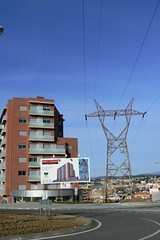
Some people complain over buzzing sounds. It guess if you live so close to a power line that you can poke on it with a stick you are entitled to forward such complaints.

"My electric neighbour"

Found in Braga near this roundabout. Today the house was not on google maps, but you can see a faint shadow of the power line pylon.

The Portuguese regulations say around 1 metre for this type of power line (I guess it is 20 kV). The people at norverde probably thought that no one would notice the power line. Maybe some one will confuse it with the clothes line and put out clothes to dry on it ...

PS:
Rumour has it that the when the company that builds the new shopping mall on the plot between the green building and FeiraNova got their permit the head quarters of one of the political parties in Braga was started being refurbished. But, who believes in rumours ...

Labels: , , , , , , , , , ,

2007-02-01

Things are moving, slowly

It is fairly easy to get the impression that Portugal is an underdeveloped country when it comes to environmental issues and understanding. But the things are starting to look better.

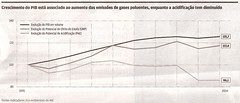
In a recent article in the daily economy newspaper Jornal de negocios a comparison was made beyween the relative evolution of GNP and two environmental indicators, CO2 and sulphur emissions. And looks like this for 1995 and 2004:

Correlation or not between environmental impact and GNP?

In relative terms a very weak improvement CO2 per GNP and a definitive improvement in sulphur emissions in relative terms although they were on the same level. Because of EU directives the sulphur content of fossil fuels have gone down leading to improvements in energy "production" but instead transport and constructions has decreased the environmental efficiency over this period. It only points to fact that it is not economy but technology and effective regulations that govern environmental impact (many neoliberal economist want to claim the opposite).

That constructions is not efficient is fairly evident, things take time, quite literally, and newly build houses are falling part only 10 years after completion. An EU directive on certification of the energy efficiency of houses (similar to the labelling of white wares) came into force a few weeks, but there is a lack of technicians to perform the certification (Metro National Portugal 2007-01-26). Not to mention the lack of know-how on how to build sustainable and energy efficient houses and other buildings ... or rather the know-how has not been translated to the persons that own construction companies and those that lead the constructions. I have a feeling that the workers do as they are told even if they know the boss is wrong.

In the same issue of JdN it says that by 2010 half government and other authority competitions for constructions and other procurements should include environmental aspects. Again, the biggest hurdle is building up buyer competence.

On a more positive note S Pedro de Moel has been chosen as the first site in Portugal for the evaluation of wave energy. Also, energy wasting light bulbs is expected to soon be subjected to a CO2 emission tax. In more general terms the current government seem to positive to the increase of biogas and innovative solar energy installations.

Even so Portugal has just abided by to EU directives that demand environmental assessment and public feedback on programmes and plans that will have considerable environmental impact. I am not sure where they draw the line.

So, things are slowly moving in the right direction for Portugal.
Boa!

Labels: , , , , , , ,

2007-01-30

Congestion tax in Portugal

Yesterday there was a sentence in an article about the recent statements from the Portugese governments on plans to become more sustainable that hinted that the government is not only positive towards congestion tax at least in the larger cities in Portugal but also started to talk with the mayors about it. Probably Lissabon and Porto.

Today came the reply in an article in Metro (national edition). On the front page it said that the municipalities do not want congestion tax. If you read the article the mayor in Porto basically says that congestion taxes are out of the question because their public transport system is lousy. His counterpart says that it is not a new question but cannot be discussed on its own. In short, they do not say no, but certainly not a strong support of the idea.

Quercus on the other hand says that congestion taxes are a bad idea as long there are cheaper ideas available such as making sure there are parking fees everywhere in the city or higher road tolls for people are alone in their cars. Putting parking meters all over Porto does not sound like a cheap deal, also Portugal has road tolls with a transponder, how do the propose to handle single drivers? In the US you can already buy inflatable "commuter buddies".

I think there is some kind of road toll for inner city traffic in Lissabon already, or at least part of the inner circular road (CRIL?). Should not be difficult to expand that.

In both cases the congestion tax could or rather should be used to improve the public transport system in the respective city!

Btw
Today I became a happy owner of two new books
State of the World 2007 Our Urban Future from the Worldwatch Institute and
100 000 000 Guinea Pigs Dangers in everyday foods, drugs and cosmetics by Arthur Kallet and F.J. Schlink writtein in 1932 printed in 1933.

The latter I managed to get hold thanks to amazon market place, but I do not understand why there are water tight sections between countries. I didn't find it on either .co.uk nor .de only on .com ...

Labels: , , , , , , ,

2007-01-09

Pescanova prefer the lenient Portuguese

If you live in Portugal you probably already have read the news about the Spanish company Pescanova building a fish aquaculture site in Mira in Algarve. Most of the fish is intended for exportation. The same factory was turned down in Galizia in Spain because it was intended to tbe built in a Natura 2000 site. The Portuguese has already given its support (both political and financial). Only problem is that the current site (Mira) in Portugal also is in a Natura 2000 site!!!

More about this on

Labels: , , , , , ,

Comunidade Portuguesa de Ambientalistas
Ring Owner: Poli Etileno Site: Os Ambientalistas
Anterior Lista Aleatório Junte-se a nós! Próximo